
Niyamgiri
Niyamgiri is a hill range, about 250 sq. km. in area (Daspatnaik P.1984) lying between19.33 degree N lat. and 83. 25 degree E longitude (Patnaik, N. and Daspatnaik, P.1982).It forms the northernmost hill in the massif of the cluster of hills called the Niyamgiris or the Dongaria Kondh country. Also known as the NiyamDongar, it runs in a southwest alignment with a maximum elevation of 1306 meters.

From socio-cultural, anthropological as well as geographic point of view, this is a singlehill-country; but from administrative point of view, the area comes three districts viz. Kalahandi, Rayagada and Koraput.
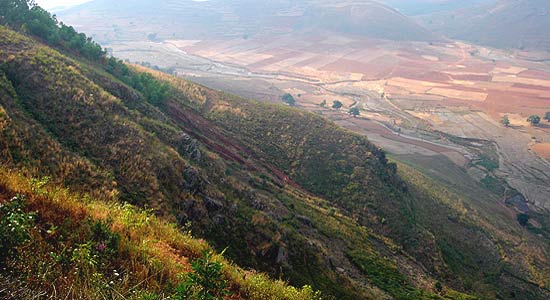
To the anthropologists, Niyamgiri Hills are better known as the country of ‘DongriaKondhs’. Dongaria Kondha is one of the primitive and scheduled tribes of the State andenjoys a critical and symbiotic relation with the Niyamgiri forests. The Dongarias believethat the hill country belongs to Niyam Raja Penu, a male deity represented by a sword andworshipped during Dussera and Jura parab. They claim themselves to be descendants of the Niyam Raja. The Dongrias have derived their name from 'dongar' meaning agriculturalland on hill slopes. If one claims to be a Dongaria Kondha, he must reside in the Niyamgiri hills andpossess land of his own, and pass on to his posterity (P.S. Daspattnaik, ‘Ownership Pattern, land

Survey and Settlement and Its Impact on the Dongaria Kondhas of Orissa’ published in ‘Adibasi’Journal in January 1984, Vol. XXIII, No. 4, p.26). The Dongrias have a distinguishedheritage, because of their dress style, mode of living, indigenous skills, cultural patternand social system interlinked with nature and forests.Both culturally and ecologically, the Niyamgiri hills are extremely rich and significant.Most importantly Niyamgiri Hills are the source of Vansadhara river as well as a majortributary of Nagavali river. It forms a distinct phytogeographical zone because of itsheight and its highly precipitous topography. It also has some of the most pristine forestsin Orissa, and is home to a number of vulnerable wildlife species including tiger,leopards, sloth bear, pangolin, palm civet, giant squirrel, mouse deer, langur and sambhar,etc. It is also on the path of migration corridor of elephants, and comes within theterritory of Royal Bengal Tiger. In view of its ecological importance, it was declared asnature conservation / game sanctuary and also was proposed as a Wild Life Sanctuary in the working plan of Kalahandi Forest Division. The State Wildlife organization has a proposal to declare this area as South Orissa Elephant Reserve as mentioned in the vidememo no. 4643/3WL(Cons) 34/04 dated 20.08.2004.
Pettition
To: all
Dear frnds
This is the pettition to our prime to say stop operation green hunt Am expecting my frinds will say am a "desh drohi" When am heard about the death of 76 CRPF jawans am thinks kishanji is a desh drohi But now i can reyalize and i can feel who is the reyal desh drohi is just take a look at theese storys and you can find me at facebook @ idukkiarun@gmail.com and my private blog is www.forwerdmd.blogspot.com
1) The niyam giri
Save the Niyamgiri HillsNiyamgiri Hills, named after the Niyamraja, the main deity of the Donagria Kondhs, are one of last untouched wildernesses of Orissa. Rising to a height of more than four thousand feet, it is the source of Vamshadhara river as well as major tributaries of Nagavali rivers. Niyamgiris form a distinct phytogeographical zone because of its height and its highly precipitous topography . It has some of the most pristine forests in Orissa. Niyamgiri flora is of ‘great phyto-geographical importance’ as the hilltops harbor high altitude plants with Himalayan/North Indian and Nilgiri/South Indian elements. Preliminary studies show that it has approximately 50 species of important medicinal plants, about 20 species of wild ornamental plants, and more than 10 species of wild relatives of crop plants such as sugarcane (protected under the International Undertaking on Plant Genetic Resources (Rome, 23 November 1983
2)The Operation green hunt
CHANDRAPUR: The first phase of the much talked about concerted operation against the Maoist rebels’ jungle bases — Operation Green Hunt —has begun in the Naxal-infested Gadchiroli district. As many as 18 companies of central paramilitary forces (CPMF) have been deployed in key Naxal infested areas identified for the offensive, close to the tri-junction of Maharashtra-Andhra Pradesh-Chhattisgarh.
These CPMF commandos have initiated search operations in coordination with the local security forces in their respective areas, sources in Gadchiroli police have said. The 1,800 CPMF commandos arrived in Gadchiroli on Wednesday last and were subsequently positioned in places identified for their deployment. “The Operation Green Hunt will be quite opposite to the one carried out in Lalgarh, West Bengal. The forces will penetrate Naxaldominated areas, clear and sanitise the locations and hold the territory so that other government agencies could move in to initiate developmental work.
And also you can see theese storys
this one http://sanhati.com/mediawatch/2269/
here
http://chhattisgarh.ozg.in/2010/04/green-hunt-corp-adivasi-maoist.html
here
http://expressbuzz.com/magazine/the-unending-war-of-kalinga/165638.html
here
http://www.hindu.com/2010/04/19/stories/2010041951410300.htm
and watch this video also
http://www.orissatv.com/specialShow.asp?glink=3&video=janamancha
This is the time to conclude who is reyaley want the operation green hunt
This is the time to declare the war aganist operation green hunt
Now say "Stop operation green hunt"
for signing this pettition
http://www.petitiononline.com/arunvmvm/petition.html
arun vm
idukkiarun@gmail.com

No comments:
Post a Comment